
The CMS market in 2025 continued to play a central role in how websites are built and managed across the internet. From content-driven platforms to ecommerce-focused systems, CMS solutions powered millions of sites used by businesses, creators, and organizations worldwide.
Throughout the year, the market showed signs of maturity rather than disruption. Established platforms strengthened their positions, while adoption trends reflected a growing focus on flexibility, performance, and long-term reliability.
This report looks at CMS market share in 2025, highlighting the platforms that dominated the market, the key trends shaping adoption, and how website needs influenced platform choice heading into 2026.
CMS Platforms Dominating the Market in 2025
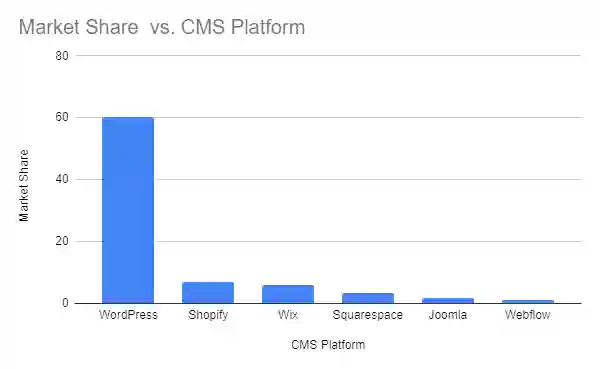
Below is a 2025 snapshot based on W3Techs CMS usage data, showing share of CMS-powered websites and share of all websites.
| CMS Platform | Market Share (%) |
|---|---|
| WordPress | 60.2% |
| Shopify | 7.0% |
| Wix | 5.9% |
| Squarespace | 3.4% |
| Joomla | 1.9% |
| Webflow | 1.2% |
WordPress: The Market Leader
Market Share: 60.2% of CMS-powered websites, 43.0% of all websites.
Why It Leads: Open-source, highly flexible, and supported by the largest CMS community, WordPress continues to power everything from personal blogs to enterprise publishing platforms. Its massive plugin and theme ecosystem allows it to adapt to nearly any website use case.
Notable Users: TechCrunch, TIME, Microsoft News.
Shopify: The eCommerce Powerhouse
Market Share: 7.0% of CMS-powered websites, 5.0% of all websites.
Why It Leads: Built specifically for online stores, Shopify offers a fully hosted platform with integrated payments, inventory management, and scalability. Its store-first approach makes it a preferred choice for businesses focused on ecommerce growth.
Notable Users: Allbirds, Gymshark, Heinz.
Wix: The All-in-One Website Builder
Market Share: 5.9% of CMS-powered websites, 4.2% of all websites.
Why It Leads: Wix appeals to users who want a fast and simple way to launch a website. Its drag-and-drop editor, built-in hosting, and pre-designed templates make it popular with small businesses and non-technical users.
Notable Users: Karlie Kloss, Playrix, various SMB brands.
Squarespace: Design-Focused CMS
Market Share: 3.4% of CMS-powered websites, 2.4% of all websites.
Why It Leads: Squarespace is known for polished templates and a tightly controlled design system. It attracts creatives, service businesses, and portfolio-driven brands that value aesthetics and simplicity.
Notable Users: Keanu Reeves, Etsy (marketing sites), creative professionals.
Joomla: The Legacy CMS
Market Share: 1.9% of CMS-powered websites, 1.3% of all websites.
Why It Leads: Joomla remains in use for sites built on its existing framework. While its adoption has declined, it continues to serve developers and organizations that rely on its established ecosystem.
Notable Users: Open-source communities, government and institutional sites.
Webflow: The Design-Led CMS
Market Share: 1.2% of CMS-powered websites, 0.9% of all websites.
Why It Leads: Webflow combines visual design tools with structured content management. It is often chosen by marketing teams and designers who want control over layouts without managing traditional CMS infrastructure.
Notable Users: Dell (marketing), Zendesk, SaaS startups.
Key Trends in the CMS Market
The CMS market in 2025 continued to mature, with platforms focusing more on stability, performance, and long-term usability. Instead of rapid experimentation, adoption patterns showed clearer preferences based on real business needs.
Continued Dominance of Flexible CMS Platforms
Flexible and extensible CMS platforms continued to lead the market in 2025. Systems that support plugins, integrations, and custom development proved more adaptable than closed platforms.
WordPress remained the strongest example of this trend. Its open ecosystem allows websites to evolve over time, which keeps adoption high across different industries.
Growth of eCommerce-Focused CMS Solutions
Ecommerce-focused CMS platforms continued gaining traction throughout the year. Businesses increasingly chose platforms designed specifically for selling online.
Shopify and WooCommerce benefited from this shift, especially among small and mid-sized businesses. Built-in payments, inventory tools, and store management features made these platforms easier to adopt.
Steady Demand for All-in-One Website Builders
All-in-one website builders maintained a stable position in the CMS market. Platforms like Wix and Squarespace remained popular with non-technical users.
Their appeal comes from simplicity and speed. Bundled hosting, templates, and visual editors allow users to launch websites quickly with minimal setup.
Rise of No-Code and Low-Code Workflows
No-code and low-code workflows continued shaping CMS adoption in 2025. Visual editors and block-based systems reduced the need for custom development.
This trend made website creation more accessible while still supporting modern layouts and features. CMS platforms that embraced visual building tools stayed competitive.
Performance and Security as Key Decision Factors
Performance and security became stronger decision factors when choosing a CMS. Website owners paid closer attention to load speed, update reliability, and long-term stability.
Platforms that offered regular updates, strong security practices, and performance optimizations earned greater trust. These factors increasingly influenced long-term CMS selection.
Final Thoughts
The CMS market in 2025 showed clear signs of stability and maturity. Leading platforms strengthened their positions by focusing on flexibility, performance, and long-term usability rather than rapid change.
WordPress remained the dominant CMS, supported by its open ecosystem and broad adoption across industries. Ecommerce-focused platforms like Shopify continued to grow, while all-in-one builders maintained steady demand among non-technical users.
Overall, CMS adoption in 2025 reflected practical decision-making. Website owners prioritized platforms that offer scalability, reliability, and ongoing support, setting the stage for more refined and purpose-driven CMS development moving into 2026.